
Thailand breed guide
Doberman in Thailand: is this breed right for you?
The Doberman is an athletic, intelligent companion developed to stay close to its person and notice what is happening around them. Its elegance can make the breed look effortless, but daily exercise, close family contact and consistent training are central to a good match.
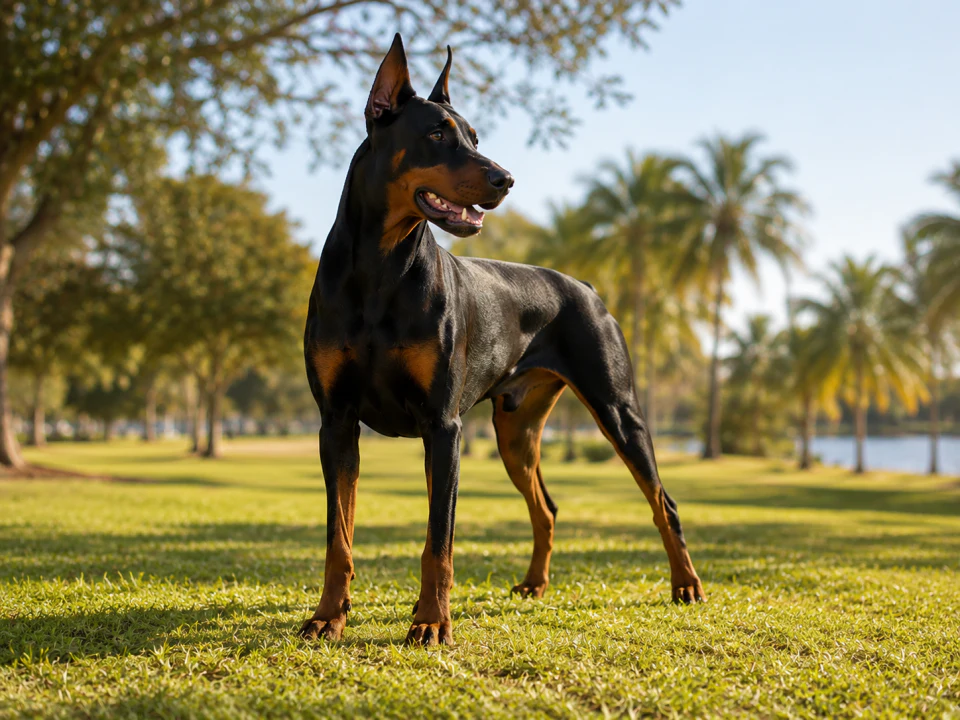
Is a Doberman suitable for life in Thailand?
Yes, for an active household wanting an involved, trainable dog and prepared to make it part of daily life. Dobermans often form close bonds and can be sensitive to their people as well as alert to the environment.
They are not well suited to being left outside or excluded from family activity. Their combination of speed, intelligence, strength and watchfulness requires early social learning and ongoing reward-based training.
Quick facts
Recognised height
About 63 to 72 cm, depending on sex
Adult build
Medium-large, muscular and athletic
Exercise
Substantial daily physical and mental activity
Grooming
Simple short-coat care
Home
Indoor family life with secure exercise space
Best suited to
Active people wanting a close working partnership
A close companion, not a garden security system
The Doberman was developed as both companion and protector. Many want frequent contact with their family and may follow their person from room to room, which is very different from a dog expected to live independently outside.
Watchfulness should be balanced by stability and responsiveness. Training should develop judgement, calmness and everyday manners, not encourage unnecessary suspicion or dramatic guarding behaviour.
Temperament and family suitability
Dobermans are often affectionate, alert and highly engaged with their household. Many learn quickly and notice small changes in people, routines and surroundings.
Confidence and sociability vary. Introduce the puppy gradually to visitors, traffic, friendly dogs, children and handling while protecting it from overwhelming or chaotic encounters.
Adult size and expected lifespan
The FCI standard describes males at about 68 to 72 cm and females at about 63 to 68 cm. Adults are muscular and substantial without the heavy build of a mastiff.
No lifespan can be guaranteed. Families should plan for a long commitment, including the space, transport, exercise and support needs of an athletic dog.
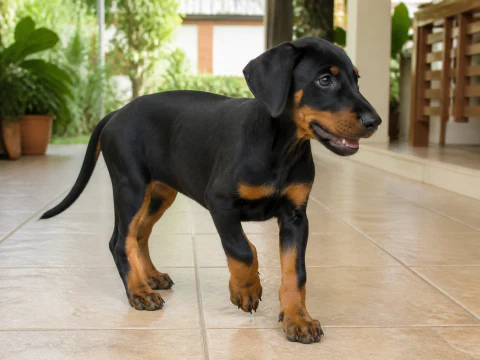
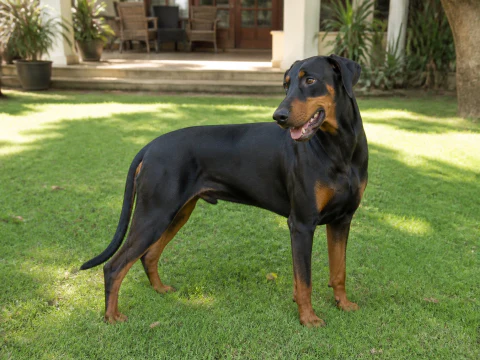
From curious puppy to athletic adult
A puppy is at the stage when calm handling, lead walking, recall, settling and positive exposure can become normal parts of life.
The adult dog shown here illustrates the lean, athletic outline that develops. A mature Doberman can move quickly and powerfully, so reliable communication and secure management should already be familiar.
Exercise and mental stimulation
Dobermans need meaningful daily activity. Walks, running when mature, scent games, obedience, tracking and structured play can provide both physical and mental work.
Exercise should be built gradually in young dogs. A well-designed day also teaches rest, because constant high arousal does not create a calm companion.
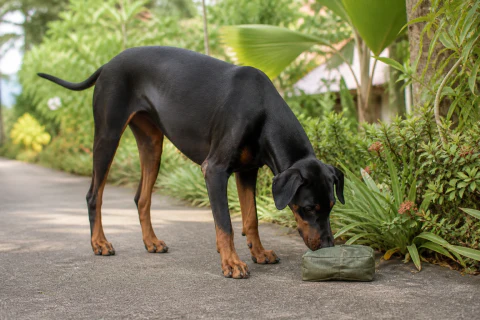
Training considerations
Reward-based training suits a dog that is observant and responsive. Prioritise recall, lead walking, waiting, settling, releasing objects and remaining connected around distractions.
Practise briefly and often. Clear routines and fair boundaries are more useful than harsh correction, particularly with a breed that may be sensitive to its handler.

Barking and independence
Many Dobermans alert when someone approaches but should also learn when the household has accepted a situation. A visitor routine and a reliable settle are valuable.
Close attachment can make sudden long absences difficult. Introduce time alone gradually and arrange realistic companionship and activity.
Grooming, shedding and smell
The smooth coat needs simple brushing and occasional bathing, with some loose hair around the home. The coat provides limited protection from strong sun and rough outdoor living.
Keep nails comfortable, brush teeth and check ears, feet and skin. Gentle handling from puppyhood makes everyday care straightforward.
Children and other animals
A well-matched Doberman can be devoted to a family. Its speed and size mean play with children needs supervision, calm rules and space for the dog to rest undisturbed.
Introductions to other animals should be controlled. Individual prey interest, confidence and social experience matter more than a general breed reputation.
Condos, gardens and time alone
The breed is happiest living indoors with its people. A secure garden is useful for activity, but it does not replace walks, training or shared time.
Condo living is possible only with unusually strong routines for exercise, lifts, corridors, visitors and time alone. Secure entrances and reliable lead control are essential anywhere.
Heat and humidity
Short hair can make the coat easy to manage, but an athletic dark-coated dog can still overheat. Exercise at cooler times, provide shade, water and cool indoor rest, and reduce intensity in humidity.
The sparse coat also means attention to sun exposure and air-conditioned environments. Comfort should be judged from the individual dog rather than the apparent simplicity of its coat.
Health and everyday care
Useful everyday care includes appropriate body condition, regular age-suitable exercise, dental care, nail trimming, skin observation and vaccination and parasite-prevention plans agreed with the family’s vet.
This guide is general ownership information, not veterinary advice. Changes in stamina, breathing, appetite, movement, digestion, skin or behaviour should be discussed promptly with a veterinarian.
How Perfect Pedigree sources Dobermans
Perfect Pedigree has helped families find Doberman puppies in Thailand since 2014. We consider temperament, upbringing, known parent information and whether the household can provide the training, activity and companionship the breed needs.
We explain the veterinary care, documentation and other information available for the individual puppy before reservation. The discussion includes adult size, daily routine and family fit rather than focusing only on colour or appearance. A person remains involved before reservation.
Typical availability in Thailand
Dobermans are available in Thailand from time to time. A suitable puppy should be chosen for temperament, upbringing and compatibility with the household, not simply for the most imposing appearance.
Available Doberman litters and enquiries
Current puppies appear by litter on Available Puppies. If none is shown, tell us about your experience, activity, household and timing so we can discuss a current or later Doberman enquiry.
Frequently asked questions
Is Doberman the same breed as Dobermann?
Yes. Dobermann is the FCI and British kennel-club spelling, while Doberman and Doberman Pinscher are widely used internationally. This page uses the more familiar customer search term Doberman.
Can a Doberman live outside?
It should live as part of the household. The short coat and strong need for family contact make permanent outdoor living a poor fit.
Is a Doberman suitable for a first-time owner?
It can be demanding for a first-time owner because of its activity, sensitivity, strength and watchfulness. A prepared person with good professional training support may manage well, but it is not an effortless choice.
Sources and authorship
- Fédération Cynologique Internationale, Dobermann Standard No. 143, used for recognised size, purpose, coat and broad temperament characteristics.
- The Royal Kennel Club, Dobermann breed information, used selectively for size, exercise, grooming and household context.
- Doberman Pinscher Club of America, temperament, used for the breed’s energetic, watchful and close-companion character.
- American Kennel Club, Doberman Pinscher breed information, used selectively for activity, training and everyday coat care.
- Perfect Pedigree’s first-hand experience helping families find and raise puppies in Thailand since 2014, including experience with Dobermans.
Breed organisations and welfare sources are used selectively for neutral facts and practical context. Their registration, health-testing and purchasing recommendations are not presented as Perfect Pedigree policy.
Would this breed suit your family?
Browse current litters or tell us what you are looking for. We will review the enquiry personally and help you understand the next step.