Everyday care
Dinner Is Served: What Should You Feed Your Puppy?
A simple guide to puppy food, portions, treats and changing diets without turning every mealtime into a science project.
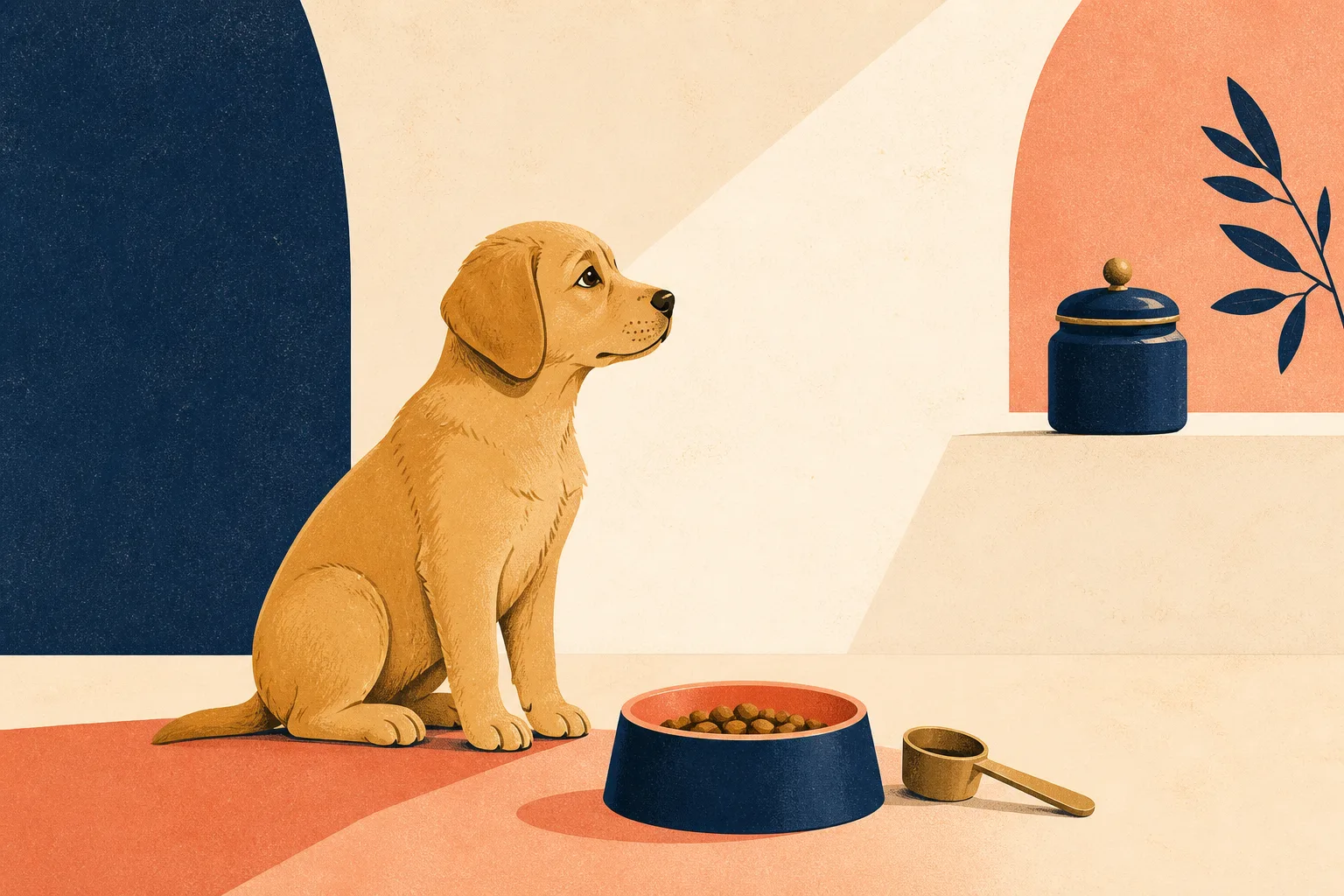
Good puppy food does not need theatre. Start with a complete food made for growth, keep the familiar routine when your puppy first comes home, and make changes gradually. Then watch the puppy in front of you: healthy growth, steady energy and a comfortable body shape tell you far more than an impressive bag ever could.
Start with what your puppy already knows
Coming home brings new rooms, new people, new sounds and, very possibly, an exciting disagreement with the household mop. Dinner can be the reassuringly familiar part. Keep the food, quantity and meal pattern from your puppy's handover at first.
If you would like to use a different food, introduce it gradually by mixing increasing amounts into the familiar one over several days. There is rarely a prize for completing the change by Tuesday. A slower transition is usually much kinder to a young digestive system.
Choose the food, not the front of the bag
Look for a food described as complete and suitable for puppies or growth. That means it is designed to provide the nutrients a growing puppy needs as the main diet, rather than needing a little of this and a sprinkle of that added at home.
A reliable maker should be able to explain who formulates the food, how quality is controlled and how many calories it provides. Ingredients matter, but the ingredients list alone cannot tell you whether the finished diet is well formulated. Calm facts are more useful than fashionable claims.
Let your puppy help with the measuring
The feeding guide on the packet is a sensible starting point, not a lifetime contract. Puppies grow at different rates and foods contain different amounts of energy, so measure the portion and keep an eye on body shape, weight, activity and stools as the weeks pass.
You should be able to feel the ribs beneath a light covering without seeing a sharply bony puppy. Adjust gradually and ask your veterinary team for help if growth or body condition is unclear. Most puppies would happily vote for six dinners, which is why the human still holds the scoop.
Make mealtimes pleasantly uneventful
A regular place and an easy rhythm help puppies settle. Fresh water should always be available, and a little of the daily food can become training rewards, a slow feeder or a simple search game. Treats still count, even when they are handed over in the name of education.
In a home with more than one pet, give everyone their own bowl and enough peace to eat. There is no need to test whether a puppy will surrender food or tolerate hands in the bowl. Teaching a cheerful swap with something worthwhile is a much better family skill.
A few questions families often ask
How often should a puppy eat?
It depends on age, size and the food being used. Follow your puppy's handover routine first, then change the number of meals gradually as they grow.
Can my puppy have human food?
The main diet should remain complete and balanced. Some everyday foods are unsafe for dogs and rich leftovers can upset a young stomach, so check before sharing and keep extras small.
Does a puppy need supplements?
Not automatically. A complete puppy food is designed to stand on its own, and adding nutrients without a specific reason can unbalance it. Ask your veterinarian if your puppy has an individual need.