
Everyday care
Puppy Vaccinations and Parasite Protection in Thailand
A clear age-by-age guide to puppy vaccines, deworming, heartworm prevention and flea and tick protection in Thailand.
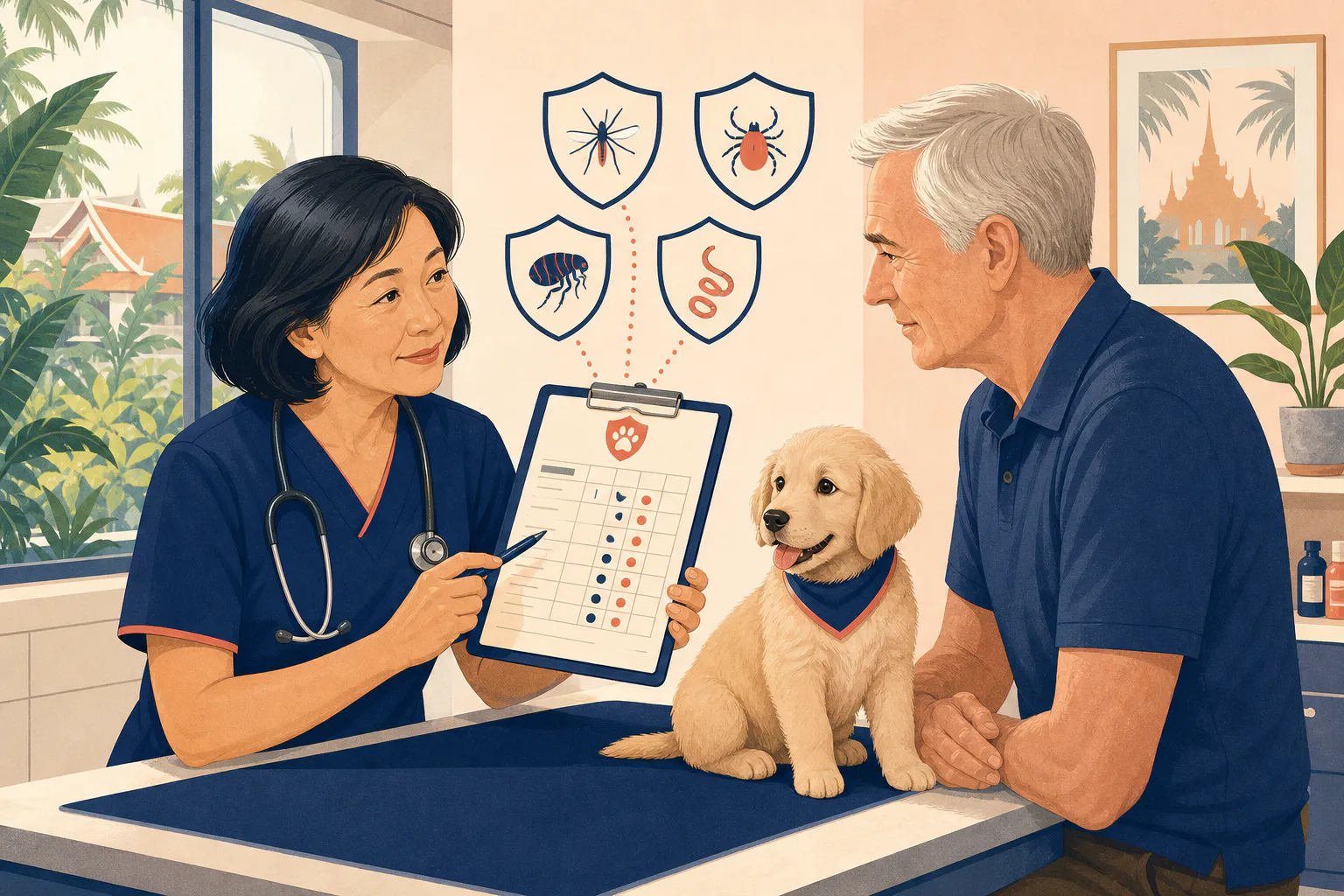
A normal puppy vaccination programme begins the core combination vaccine at 6 to 8 weeks and repeats it every 3 to 4 weeks until the puppy is at least 16 weeks old. Rabies normally begins at 12 weeks in Thailand. Leptospirosis is usually given as two initial doses 2 to 4 weeks apart. Deworming begins much earlier, then moves into monthly year-round protection against intestinal worms, heartworm, fleas and ticks. Here is the schedule in plain English.
6 to 8 weeks
The first core vaccination and the handover from very early deworming to regular preventive care.
- Core combination vaccine
- First DHP or DHPP dose. This protects against distemper, adenovirus or infectious hepatitis and parvovirus, usually with parainfluenza included. It should start no earlier than six weeks.
- Intestinal worms
- Puppies should already have been dewormed from two weeks of age and then every two weeks through eight weeks. Treatment covers common puppy worms such as roundworm and hookworm.
- Heartworm prevention
- Year-round prevention can usually begin from six to eight weeks, depending on the product label and puppy's weight. Heartworm is transmitted by mosquitoes, so an indoor lifestyle does not remove the risk.
- Flea and tick protection
- Begin a puppy-safe product as soon as its label permits. In Thailand, protection should continue throughout the year rather than stopping for a cold season that never really arrives.
10 to 12 weeks
The next core dose and the usual starting point for rabies and leptospirosis.
- Core combination vaccine
- Give the next DHP or DHPP dose 3 to 4 weeks after the previous one. A single early injection does not complete the puppy series.
- Rabies
- Thailand Department of Livestock Development guidance begins rabies vaccination at 12 weeks of age. Rabies vaccination is essential in Thailand and for later travel.
- Leptospirosis
- The first dose is commonly given from about 8 to 12 weeks, depending on the vaccine used. Leptospirosis is spread through infected urine and contaminated water or ground.
- Monthly parasite protection
- After the early fortnightly deworming stage, continue monthly intestinal-worm and heartworm prevention, plus regular flea and tick control at the product's stated interval.
14 to 16 weeks
The important final stage of the primary puppy series.
- Core combination vaccine
- Give another DHP or DHPP dose so the final routine puppy dose is administered at 16 weeks or older. In a particularly high-risk setting, the veterinarian may continue the series to 18 or 20 weeks.
- Rabies
- Under current Thai guidance, give the second puppy rabies dose 2 to 4 weeks after the first. If rabies was given before 12 weeks, the series still needs two doses from 12 weeks.
- Leptospirosis
- Give the second initial dose 2 to 4 weeks after the first. Both doses are needed to complete the initial course.
- Keep protection continuous
- Continue monthly worm and heartworm prevention and uninterrupted flea and tick control. Record the product, puppy's weight, date given and next due date.
From 6 to 12 months
Complete the first-year boosters, then settle into the adult calendar.
- Core combination booster
- WSAVA recommends considering a DHP booster at about six months rather than waiting until 12 to 16 months. After that, core DHP boosters are normally no more frequent than every three years.
- Rabies booster
- Thai guidance calls for a booster at one year of age and then annual rabies vaccination. Keep the signed entries because rabies dates also matter for travel.
- Leptospirosis booster
- Boost within one year of the initial course and then annually while the risk remains relevant.
- Parasites and testing
- Continue year-round worm, heartworm, flea and tick protection. Arrange annual heartworm testing and regular faecal checks; CAPC recommends four intestinal-parasite checks during the first year.
What do DHP, DHPP and the other names mean?
DHP is the essential combination covering canine distemper, canine adenovirus and canine parvovirus. The adenovirus component also protects against infectious canine hepatitis. DHPP adds parainfluenza, a respiratory infection. Clinics may use names such as DAPP, DA2PP, five-in-one or six-in-one depending on the manufacturer and whether leptospirosis is included.
Leptospirosis and rabies have their own initial and booster schedules. Bordetella or canine influenza may be recommended for a dog that will board, attend daycare, visit shows or mix frequently with unfamiliar dogs. Those lifestyle vaccines are additions, not substitutes for the core series.
Why are several puppy injections necessary?
Antibodies received from the mother protect a very young puppy but can also block an early vaccine. Nobody can identify the exact week those maternal antibodies will fall in every individual puppy, so the core vaccine is repeated through at least 16 weeks. The later dose is not an unnecessary repeat; it closes the period when an earlier dose may not have produced full protection.
This is also why “my puppy has had a vaccine” and “my puppy has completed the puppy vaccination series” are not the same statement. Use the dates in the booklet, not the number of stickers on one page.
The parasite plan for life in Thailand
Intestinal worms can be passed before birth, through milk or from contaminated ground. Heartworm is carried by mosquitoes. Fleas and ticks can enter gardens, homes, grooming premises and vehicles. In a tropical climate, these are year-round risks, so regular prevention is more sensible than waiting to see a parasite.
Use a product or combination that covers the required parasites and is labelled for the puppy's age and current weight. Some products cover several risks at once; others do not. Never assume that a flea product prevents heartworm or that an ordinary dewormer covers every intestinal parasite. The packaging and veterinary record should say exactly what it covers and when it is due again.
What Perfect Pedigree does before delivery
Every Perfect Pedigree puppy visits a qualified, registered veterinarian at least twice. The pre-delivery programme includes a comprehensive physical examination, complete blood count, blood biochemistry, blood-parasite testing, a parvovirus antigen test and faecal microscopy for protozoa, internal parasites, worm eggs and abnormal bacterial activity.
The puppy also receives the vaccinations appropriate to their age and veterinarian-selected internal and external parasite treatment. The original vaccination booklet, health report, laboratory results and identification documents travel with the puppy, and the next vaccination or booster date is recorded. If the puppy comes home before 16 weeks, the family completes the remaining series from that record; Perfect Pedigree does not describe an age-appropriate first or second dose as a completed lifetime programme.
A few questions families often ask
When is my puppy fully vaccinated?
For the core DHP or DHPP series, the final routine puppy dose should be given at 16 weeks of age or older. Rabies and leptospirosis have separate two-dose initial courses. Check that all three parts are complete rather than relying on the phrase “fully vaccinated.”
Can my puppy walk outside after the first vaccine?
Not on busy dog-contaminated ground. Before the core series is complete, use carrying, a clean mat, the car, private clean spaces and known healthy vaccinated dogs. The separate socialisation and parvovirus guides explain how to keep life interesting without choosing high-risk ground.
Does an indoor puppy need heartworm, flea and tick protection?
Yes. Mosquitoes enter homes, and fleas and ticks arrive through gardens, people, other animals and grooming visits. Year-round protection is the normal approach in a tropical country.
What if a vaccination or parasite dose is late?
Do not double it. Take the booklet and product details to the clinic. A late core vaccine usually means continuing or resuming the series rather than starting every vaccination again, but the dates and product instructions determine the answer.
Can one monthly product cover everything?
Some broad-spectrum products cover heartworm, several intestinal worms, fleas and ticks; others cover only part of that list. Read the coverage rather than assuming. Tapeworm, Giardia or another diagnosed parasite may require separate treatment.